
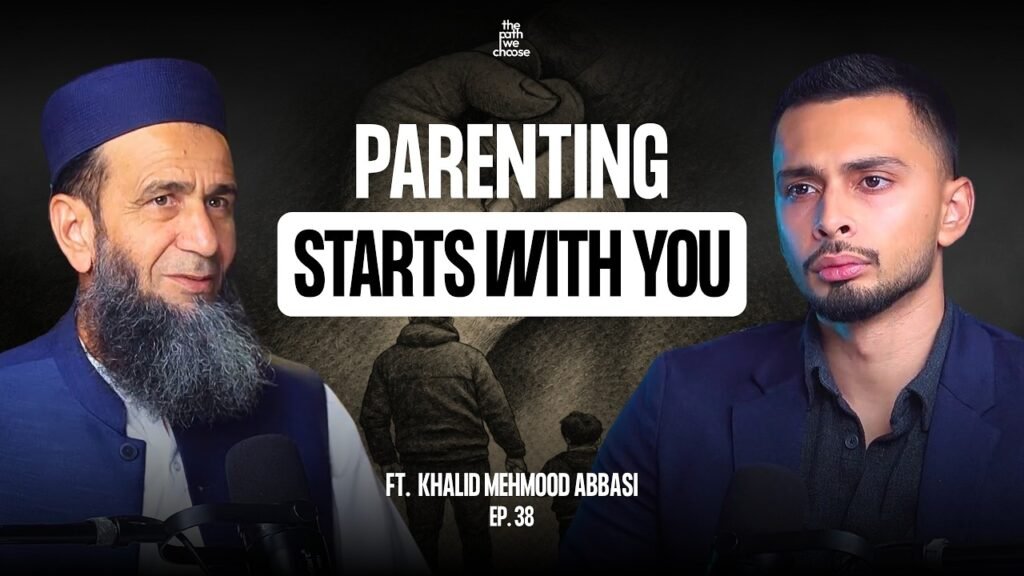
What Holds A Family Together| Khalid Mehmood Abbasi | Ep. 38
Hey everyone, Umer here!
Most parents want the best for their children.
They think about the best schools, the best tutors, Quran teachers, and the opportunities they can provide.
But one important question often gets ignored:
Are we focusing enough on the people who are shaping the child every single day?
That was the heart of this conversation with Khalid Sahib. The discussion explored Muslim parenting, family, marriage, early childhood development, discipline, responsibility, and how parents can create the right foundation for their children.
Because before a child learns from a classroom, they learn from the home they grow up in.
“The family is the human nursery.”
Here’s what I learned.
The Child’s First Environment Is The Family
A child’s development does not begin when they enter school.
It begins at home.
The family is the first environment where a child experiences love, security, values, and relationships. This is why Islam places so much importance on maintaining a strong relationship between husband and wife.
A child does not only need parents who provide for them.
They need parents who create an environment where they can grow.
The foundation is built before any formal education begins.
Are We Raising Humans Or Just Performers?
One of the biggest problems today is that many parents view children through the lens of achievement.
The focus becomes the best school, the best career, the best lifestyle, and the things parents can proudly show to others.
But somewhere along the way, the goal of raising a good human being can get lost.
A child can have success and still lack character.
They can have knowledge and still lack wisdom.
The real question is not only what future we want our children to have, but what kind of people we want them to become.
Children Learn Before They Are Taught
The early years of a child’s life are not mainly about formal teaching.
They are about observation.
Children watch their parents. They copy their habits, their language, their emotions, and their actions.
Before a child learns through instructions, they learn through imitation.
That is why parents cannot only tell children what is right.
They have to show them what is right.
A child who sees prayer, kindness, patience, and respect at home naturally begins to understand those values.
Freedom Is Part Of Learning
The conversation highlighted an important point about children before the age of seven.
This stage is not about controlling every action.
It is about allowing children to experience, explore, and learn naturally.
Children learn by trying things, making mistakes, and understanding the world around them.
Sometimes parents rush to correct every small thing, but children also need space to develop confidence and awareness.
The goal is not to remove every mistake.
The goal is to create an environment where they can learn from those experiences.
The Child Should See The Values At Home
A child’s understanding of good and bad begins with what they experience around them.
If a child sees certain values being practiced by their parents, those values become normal to them.
They do not need constant reminders because they have already seen what those values look like.
The example of parents becomes the standard through which children understand the world.
That is why character cannot simply be taught.
It has to be lived.
Parenting Is Not About Control
As children grow older, parents naturally have to guide them more directly.
But guidance does not mean creating rebellion through excessive control.
The conversation emphasized that parents need wisdom in how they correct children.
The goal is not to break the child’s confidence.
The goal is to help them understand, reflect, and make better choices.
Sometimes patience, explanation, and forgiveness create more change than harshness ever could.
A Strong Marriage Creates A Strong Foundation
The relationship between parents is one of the biggest influences on children.
Children observe how their parents speak to each other.
They observe how they handle disagreements.
They observe whether there is love, respect, and appreciation in the home.
No marriage is free from challenges.
But those challenges should not destroy the emotional safety of the child.
When children repeatedly witness conflict and disrespect, it affects the way they understand relationships.
A Father’s Role Is More Than Providing
The conversation also explored the responsibility of fathers in building the family environment.
A father’s role is not only financial provision.
It is creating protection, stability, and security for the family.
The discussion emphasized that a father should build trust with his wife and ensure that she feels supported and cared for.
Because a satisfied and secure mother creates a healthier environment for the child.
“The child spends the most time with the mother, and a satisfied mother is the best incubator for the child.”
Relationships Need Both Love And Respect
One of the deeper lessons was about balancing closeness and authority.
Children need love.
They need affection.
They need connection.
But they also need boundaries and respect.
A parent who is only strict can create distance.
A parent who removes every boundary can lose authority.
The balance is creating a relationship where the child feels loved while also understanding responsibility.
That balance is what helps children grow into mature adults.
The Teenage Years Reveal The Foundation
The teenage years are often considered one of the most difficult stages of parenting.
At this stage, parents cannot rely only on control.
The relationship they built during the earlier years becomes their biggest influence.
If the foundation is strong, even disagreements can be handled with understanding.
But if there was no connection before, authority alone will not create closeness.
The relationship has to be built before the difficult moments arrive.
Lead By Example
The biggest lesson from this conversation is simple:
Before trying to change your child, look at what you are showing them.
Children learn from the environment around them.
They learn from how parents treat each other.
They learn from how parents respond to challenges.
They learn from the values they see practiced every day.
The greatest gift parents can give their children is not only education or opportunities.
It is becoming the example they can follow.

If this resonated with you, the full episode goes deeper into Luqma, clean water, microfinancing, social responsibility, accountability, Islam as a complete way of life, nationalism, character, and why real change begins with the person willing to take the first step.
Watch Full Episode
Thanks for tuning in. I hope this episode encourages you to live authentically and embrace your own path with resilience.
Best,
Umer Farooque
Host, The Path We Choose