
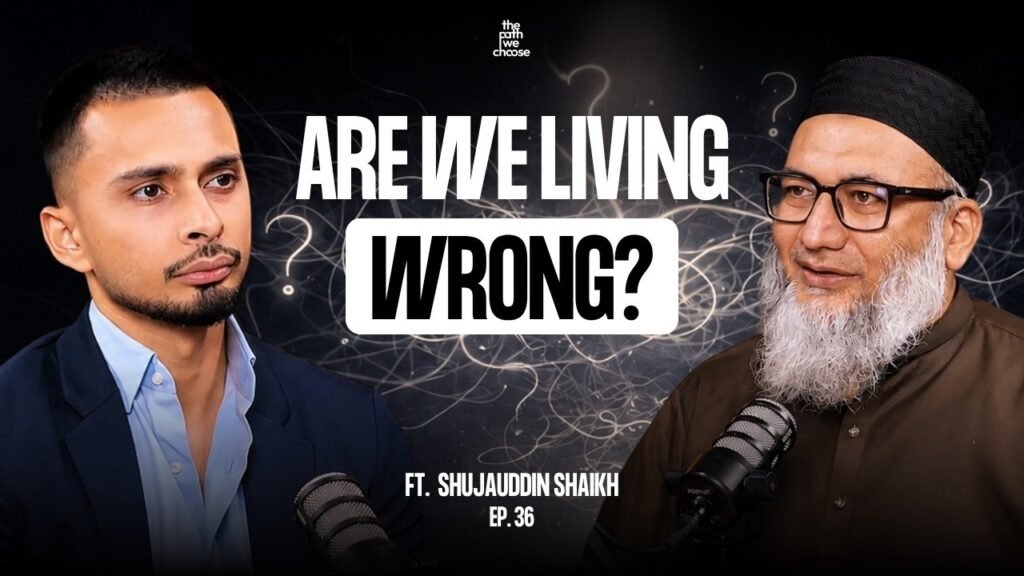
Islam Is Not Just A Religion | Shujauddin Shaikh | Ep. 36
Hey everyone, Umer here!
A lot of Muslims know Islam is important. But the real question is whether Islam has become our mission, or whether it has become something we keep on the side while chasing everything else.
That was the heart of this conversation with Shujauddin Sheikh. The episode moved through Quran, materialism, purpose, politics, parenting, youth, imams, emotional intelligence, and what it really means to submit your life to Allah.
“Islam is not just a religion. Islam is deen.”
Here’s what I learned.
Think Bigger
Shujauddin Sheikh began by talking about his own journey. He was in chartered accountancy, a respected and lucrative field, but through the influence of Dr. Israr Ahmed and the Quran, he began to see service of Allah’s deen as a higher calling.
That was the first major lesson.
A good career is not wrong. Education is not wrong. A house, marriage, comfort, and financial stability are not wrong. But if these things become the ceiling of our ambition, then we have misunderstood why we were created.
Even birds build homes and feed their young. A Muslim has to think beyond survival.
Materialism Has Trapped Us
One of the strongest points in the conversation was how deeply materialism has entered the Muslim mind.
We prioritize education, careers, homes, cars, and worldly status, while the Quran, akhirah, and the purpose of life become secondary.
But our faith begins with the unseen. Allah, the akhirah, the soul, accountability, Jannah, and Jahannam are not visible to the eye, but they are the foundation of how a Muslim sees reality.
If we only believe what we can see, then we are no longer thinking like people of iman.
Islam Is Deen, Not Just Religion
Shujauddin Sheikh explained that the English word “religion” does not fully capture Islam. Religion is often understood as private worship, personal rituals, and individual beliefs.
Islam is bigger than that.
Islam is deen. It is a complete system of life. It speaks about personal life, family life, social life, economic life, political life, and the life of the state.
That distinction matters because when Islam is reduced to private rituals, Muslims begin to think that salah and fasting are Islam, while everything else can be borrowed from other systems.
But Islam is complete submission.
Submission Is Twenty-Four Hours
Another powerful reminder was that Allah is not our Lord for only two rakats on Friday or only during Ramadan. Allah is our Lord twenty-four hours a day.
So worship cannot be limited to prayer, fasting, zakat, and Hajj.
Looking at your parents with love can be worship. Treating your spouse well can be worship. Raising children properly can be worship. Earning halal can be worship. Resting with the intention of regaining energy to serve Allah can be worship.
Islam is not occasion-bound.
It is not ten days of Islam, forty days of Islam, or three days of Islam after someone dies. Islam is a full way of life.
Politics Affects Everyone
The conversation also challenged the idea that Muslims should avoid politics completely.
Shujauddin Sheikh explained that politics, in its real meaning, is administration. A home needs administration. A masjid needs administration. A company needs administration. A city and country need administration too.
So politics itself is not evil.
What is evil is hypocrisy, corruption, lying, self-interest, injustice, and using politics as a tool to exploit people.
Islam speaks about governance because governance affects people. Roads, taxes, poverty, courts, justice, safety, corruption, and law all affect ordinary lives.
If Islam is concerned with justice, then Islam cannot be silent about systems that create injustice.
Pakistan Has A Responsibility
One of the most direct parts of the conversation was about Pakistan.
Shujauddin Sheikh reminded listeners that Pakistan calls itself the Islamic Republic of Pakistan. The country was not created for interest, shamelessness, corruption, and injustice.
The common factor that holds Pakistan together is Islam. Different languages, foods, tribes, regions, and cultures exist across the country, but Islam is the shared identity.
That means Muslims in Pakistan cannot treat Islam as a slogan only. If we claim Islam, then we have to ask whether Allah’s command is actually being honored in our laws, institutions, public life, and personal conduct.
We Must Understand The Quran
A major theme was that many Muslims recite the Quran, but do not understand it.
Children are taught to finish the Quran, but not always to understand what Allah is saying. They learn pronunciation, but not meaning. They complete the book, but the book does not become the guide of their life.
That is a huge problem.
The Quran is not just a book of reward and respect. It is a book of guidance and revolution. It is meant to shape how we think, live, decide, build families, lead communities, and organize society.
Guidance will only come when we understand it.
Parents Are Responsible Too
The conversation then moved into parents and how they think about investment.
Parents will spend huge amounts of money on education, foreign universities, English, French, Chinese, careers, and worldly success. But many do not give the same seriousness to their child’s relationship with the Quran and deen.
That is a painful imbalance.
A child is not just a worldly investment. A righteous child can become sadaqah jariyah. A righteous child can become comfort in the grave and a source of elevation in Jannah.
So parents have to stop treating deen as a secondary subject.
Imams Need To Be Connected To People
Another important section was about imams, scholars, and religious leaders.
The point was not to attack them. It was to say that religious leadership needs grooming, training, emotional intelligence, and connection with people.
An imam’s responsibility does not end after leading salah.
A good imam builds relationships. He knows the young people. He helps families. He supports people in crisis. He shows up when someone’s father is in the hospital. He helps resolve issues. He becomes someone people can trust.
That is how the perception changes.
Not by complaining about “the molvis,” but by highlighting good examples and helping others improve.
Criticism Is Not Enough
One line from the conversation really stood out: we are either part of the problem or part of the solution.
That applies to all of us.
It is easy to criticize imams. Easy to criticize parents. Easy to criticize politicians. Easy to criticize society. But if we are not playing a role in correction, then we are not helping.
The question is not only what is wrong.
The question is: what am I doing to fix it?
Da’wah Needs Emotional Intelligence
One of the strongest practical lessons was about how we speak to young people.
If a young person comes to an imam and says they are struggling with something haram, the first response cannot only be anger, shame, and condemnation. The fact that they came at all means there is still some concern in their heart.
Shujauddin Sheikh used the example of the young man who came to the Prophet ﷺ asking permission for zina. The Prophet ﷺ did not dismiss him. He listened, reasoned with him, touched his heart, and made dua for him.
That is the model.
People need truth, but they also need wisdom. They need to feel heard before they can understand.
The Sunnah Is Bigger Than Symbols
The episode ended with a powerful reminder about the Prophet ﷺ.
Yes, the Prophet ﷺ taught us about the beard, miswak, fragrance, and outward sunnahs. These things matter. But his mission was much bigger than symbols.
The Prophet ﷺ carried the Quran, called people to Allah, suffered in Ta’if, migrated, struggled, sacrificed, and established the deen of Allah.
If we remember the sweet things and forget the sacrifice, we have misunderstood the seerah.
The mission of the Prophet ﷺ was not only to teach private goodness. It was to establish Allah’s guidance as a complete way of life.
The Best Career Is Serving The Quran
The final message was clear: if someone wants to build a career, build it around the Quran and the mission of the Prophet ﷺ.
That does not mean everyone must leave their job. It means every Muslim should ask what role they are playing in serving Allah’s deen.
Because one day, we will stand before Allah.
And the question will not only be what we earned, where we lived, what car we drove, or what degree we had.
The question will be: what did we bring for Allah?
If this resonated with you, the full episode goes deeper into masculinity, brotherhood, self-improvement, entrepreneurship, ego, relationships, character, social media, and what it means for a man to become who he truly wants to be.
Watch Full Episode
Thanks for tuning in. I hope this episode encourages you to live authentically and embrace your own path with resilience.
Best,
Umer Farooque
Host, The Path We Choose