
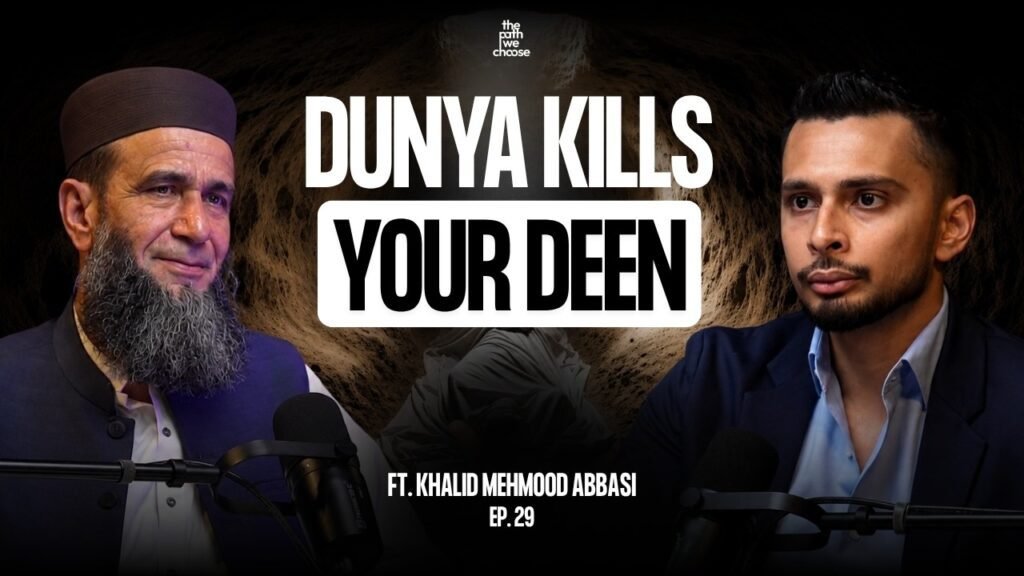
Ep. 29: The Hidden Cost of Chasing Dunya | Khalid Mehmood Abbasi
Hey everyone, Umer here!
What if the path is not something we choose, but something we are chosen for?
Purpose does not become clear when life is comfortable. It usually becomes clear when a person starts asking deeper questions. In this conversation with Khalid Sahib, the discussion moved from survival to purpose, from dunya to akhirah, and from simply reading the Quran to allowing it to guide the way we think, choose, and live.
“Wherever there is life, struggle is part of it.”
Here’s what I learned.
Life Is More Than Survival
Khalid Sahib explained that every living being struggles to survive. Animals look for food, shelter, and reproduction. Humans often do the same, just with better quality, better homes, better food, better comfort, and better lifestyles.
But a thinking person cannot stop there. At some point, the questions become bigger: Who am I? Why am I here? Where did I come from? What happens after death?
“Real life is the life of the Hereafter.”
That line reframes everything. This world is not the full story. It is only the beginning, a preface to the real life that follows. Once a person understands that, hardship no longer breaks them in the same way.
Struggle Creates Clarity
One of the strongest ideas in the episode was that struggle wakes people up. When life is smooth, most people simply follow the trend. They do what neighbours do, what friends do, what society expects, and never stop to ask why.
But when shocks come, a person is forced to think. Pain, disappointment, and mental pressure can open doors that comfort never opens.
“Sometimes it takes hardship for us to truly understand.”
That does not mean hardship is easy. It means hardship has a role. It pulls a person out of routine living and makes them look for reality beyond what the world keeps selling them.
Marriage Needs Purpose
The conversation then moved into marriage and why people often approach it without thinking. Many marry only because society tells them to marry by a certain age. Then they get caught in expectations, expenses, in-laws, status, and pressure.
Khalid Sahib explained that marriage becomes different when it is tied to a purpose. It is no longer just a social milestone. It becomes a responsibility connected to family, lineage, character, and the larger purpose of life.
“Now marriage is no longer just a social step, it is guided by a purpose.”
That changes what a person looks for. Looks, status, and family image become secondary. Alignment becomes more important. The question is no longer just, “Can I get married?” It becomes, “Will this marriage support the purpose Allah has placed in front of me?”
The Quran Activates What Is Inside You
One of the most interesting parts of the conversation was Khalid Sahib’s analogy of the human being as hardware with certain apps already installed by Allah. Those inner faculties exist, but many remain dormant until they are activated.
According to his explanation, the Quran does not just provide information. It activates what Allah has already placed inside a person. It breaks the shell around the seed so the potential inside can begin to grow.
“This is how the Quran connects with the inner programming of a person.”
That idea makes the Quran feel alive. It is not only something to recite for reward. It is guidance that awakens the heart, sharpens the mind, and directs the person toward the purpose they were created for.
Reading Is Reward, Understanding Is Guidance
Khalid Sahib made an important distinction. Reading the Quran without understanding still carries reward and spiritual benefit. But guidance is a different level, and guidance requires understanding.
A person can collect good deeds, but without guidance, they may still lose their way in how they treat people, make decisions, and live their life.
“Guidance will only come when you understand it.”
That line is central to the episode. The Quran is Allah’s message, and a message is meant to be understood. Translation, tafsir, teachers, Arabic, reflection, and repeated engagement all become part of the process of letting the Quran move from the tongue into the conscience.
The Sunnah Makes The Quran Practical
The conversation also addressed the importance of Sunnah. Khalid Sahib explained that the Quran gives guidance, but the Prophet Sallallahu Alaihi Wasallam shows us how to live it. Without the Sunnah, even words like salah can be misunderstood in many different ways.
The Prophet Sallallahu Alaihi Wasallam was sent as a teacher. He clarified meanings, demonstrated practice, and removed confusion from the path.
“The Sunnah of the Messenger brings ease.”
That was a powerful reminder. Sunnah is not there to make Islam harder. It makes the meaning clear. It takes something that could be interpreted in many directions and gives it a lived form.
Difference Does Not Have To Become Division
Another important part of the episode was the discussion around different ways of praying. Khalid Sahib explained that the main structure of prayer is the same across the schools of thought. The differences are usually in the finishing details.
Some place their hands differently. Some leave them open. But these differences were not invented randomly. Each school connected its method back to some form of the Prophet’s practice.
“Does disagreement create a problem? No, it does not.”
The issue is not the difference itself. The issue is the narrowness of mind. If a person understands that different schools preserve different aspects of the Sunnah, then differences become easier to respect instead of turning into conflict.
Think Before You Follow
Toward the end, the conversation returned to young Muslims and how they should build their foundation. Khalid Sahib did not say that education, business, marriage, or earning money are wrong. His point was that these things should not become the purpose of life.
A person should not simply follow the crowd because everyone else is doing the same thing. Before choosing a path, they should ask why they are choosing it.
“You should be able to think and choose for yourself.”
That line is simple but important. A Muslim should not live only by trend, pressure, or imitation. They should think, understand, and make choices with intention.
Your First Dawah Is Your Own Home
The conversation also touched on dawah, social media, men, women, and responsibility. Khalid Sahib made it clear that before anyone speaks to the world, they have to look at their own home, their own actions, and their own obligations.
Dawah is not only public speaking, podcasts, or social media. It begins with yourself and your family. If a person neglects their responsibilities while preaching to others, the words lose their weight.
“Protect yourselves and your families.”
That applies to both men and women. Men must fulfill their responsibilities. Women can also serve the deen through the spaces available to them, whether in private gatherings, closed forums, creative work, teaching, or guidance. But no one should sacrifice their primary obligations in the name of public service.

If this resonated with you, the full episode goes deeper into purpose, struggle, marriage, Quran, Sunnah, sectarian differences, personal responsibility, and what it really means to build a life around Allah instead of simply following the world.
Watch Full Episode
Thanks for tuning in. I hope this episode encourages you to live authentically and embrace your own path with resilience.
Best,
Umer Farooque
Host, The Path We Choose