
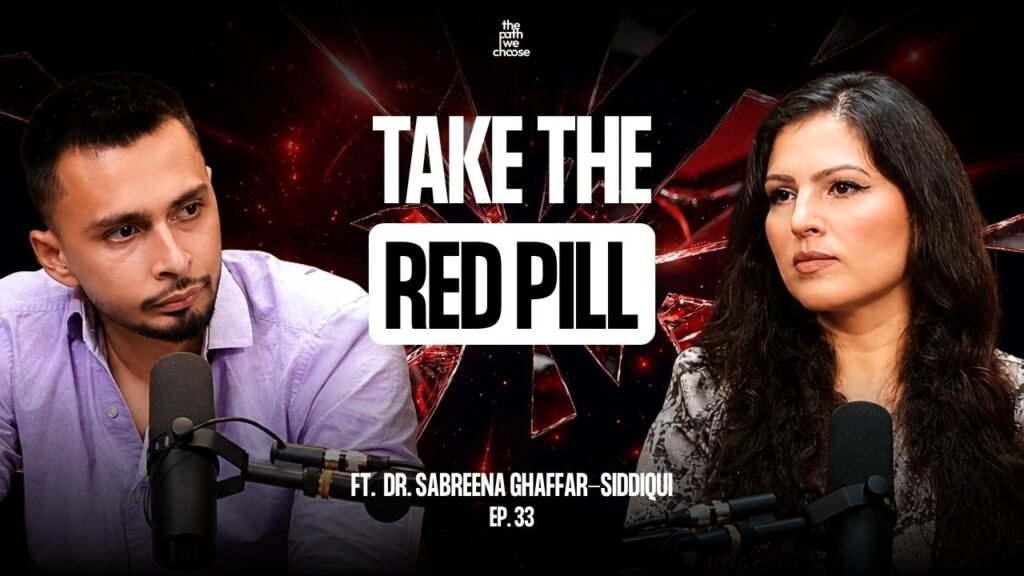
Your Comfort Is Holding You Back | Dr. Sabreena Ghaffar-Siddiqui, Ph.D. | Ep. 33
Hey everyone, Umer here!
Palestine is not just a political issue. It is a mirror. It shows us what we are willing to see, what we are willing to ignore, and what systems we are still too comfortable inside of.
That was the heart of this conversation with Dr. Sabrina. The discussion moved through Palestine, Sudan, Congo, media, trauma content, tribalism, faith, fear, job loss, purpose, and the legacy we leave behind.
“Palestine is the red pill moment.”
Here’s what I learned.

The Red Pill Comes With A Cost
Dr. Sabrina explained Palestine as the red pill moment because it forces people to choose between comfort and truth. The blue pill lets you keep living as if nothing is wrong. The red pill means you see the system clearly, even when that clarity costs you something.
“Taking the red pill” is not just about knowing what is happening. It is about being willing to risk comfort, career, reputation, and belonging for the sake of truth. That is what makes it difficult. A lot of people want awareness without consequence, but real awareness eventually asks something from you.
Selective Empathy Is Real
One of the hardest parts of the conversation was the question of why some suffering moves us more than other suffering. Palestine dominates many of our feeds, but Sudan, Congo, Kashmir, and other places are often pushed to the margins.
That forced a deeper question: do we care because people are suffering, or do we care because our algorithm, community, or identity has made this particular suffering visible to us?
Dr. Sabrina did not excuse that gap, but she did explain it. Most people are not actively searching for the pain of the world. They respond to what is shown to them. That means our empathy is often being shaped before we even realize it.
Social Media Can Wake Us Up And Pacify Us
The conversation also unpacked the double role of social media. On one hand, it can educate, mobilize, and spread truth faster than almost anything else. On the other hand, it can make us feel like watching, sharing, and reposting is the same as action.
“Social media is the opiate of the masses.”
That line stayed with me. The same platforms that expose us to injustice can also numb us with entertainment, reels, celebrity updates, and endless distraction. We can be informed and pacified at the same time. That is the danger.
Get Out Of Your Algorithm
A major takeaway was that decolonizing the mind requires leaving your usual circles. If your feed only shows you your own people, your own pain, and your own political concerns, then your empathy will stay narrow.
Dr. Sabrina explained that we need to immerse ourselves in communities we are not naturally part of. Go to different mosques. Learn from people outside your background. Listen to communities whose struggles are not already in your feed.
That is how suffering becomes human. Not because an algorithm showed it to you, but because you actually know people, hear them, and begin to care about what they carry.
Trauma Content Needs Ethics
One of the strongest sections was about the way suffering is shared online. We need people to know what is happening, but we also have to ask whether the way we share pain is ethical.
If every image becomes a tool for views, outrage, or fear, we may end up dehumanizing the very people we are trying to defend. Dr. Sabrina spoke about how repeated images of suffering can desensitize people and reduce entire communities to pain.
The point is not to hide injustice. The point is to humanize people, not turn their worst moments into content. Names matter. Stories matter. Dignity matters.
Do Not Do The Colonizer’s Work
Another powerful idea was that fear itself can become a tool of control. If every story we share says, “Speak up and you will lose everything,” we may unintentionally discourage people from speaking at all.
Dr. Sabrina reframed her own job loss in a completely different way. She did not want it treated as a sad story or a warning. She saw it as something that freed her from a system and opened the door to a much larger platform.
That shift matters. The story is not “look what happens when you speak.” The story is “look what Allah can open when you refuse to stay silent.”
Your Classroom Might Become The World
One of the most moving parts of the conversation was Dr. Sabrina reflecting on losing her classroom. She loved teaching. She missed her students. But later she realized that perhaps Allah had not taken her classroom away, He had expanded it.
“My classroom was actually gonna be millions of people, not thirty people.”
That is the kind of line that changes how you see loss. Sometimes we think a door closing means the dream is over. But sometimes Allah is redirecting the dream into something wider than we could have imagined.
Justice Is Not Only A Muslim Cause
The conversation also challenged the idea that Palestine should only matter because Palestinians are part of the ummah. Faith can be the reason we care, but Islam does not teach us to care only about Muslims.
Dr. Sabrina explained that Palestine should symbolize the freedom of all oppressed people. If we reduce every issue to only Muslim suffering, we will fail to care about Congo, or any other people harmed by colonialism, extraction, and imperial power.
Faith should expand our moral concern, not shrink it.
Tribalism Makes Us Small
The episode kept returning to tribalism. Whether it is religious, cultural, ethnic, national, or political, tribalism makes people more interested in claiming stories than learning from them.
Dr. Sabrina gave the example of a story she shared about a moth and a fly. Instead of focusing on the lesson, people in the comments fought over which religion or culture the story belonged to.
That is the problem. We are so quick to claim, defend, and argue that we miss the wisdom in front of us. The real war often starts inside the mind.
Legacy Is The Question
Toward the end, Dr. Sabrina said the question people should ask themselves is simple: what is your legacy?
“What will people say when you die?”
That question brought the whole conversation together. Decolonizing the mind is not about reaching some perfect endpoint. It is about never stopping the effort. It is about leaving behind courage, justice, faith, integrity, and a record of trying.
The goal is not to guarantee that we will see justice in our lifetime. The goal is to keep fighting for it anyway.
If this resonated with you, the full episode goes deeper into Palestine, social media, trauma content, Sudan, Congo, tribalism, faith, justice, job loss, and what it really means to live in a way that leaves behind something worth remembering.
Watch Full Episode
If this resonated with you, the full episode goes deeper into purpose, struggle, marriage, Quran, Sunnah, sectarian differences, personal responsibility, and what it really means to build a life around Allah instead of simply following the world.
Watch Full Episode
Thanks for tuning in. I hope this episode encourages you to live authentically and embrace your own path with resilience.
Best,
Umer Farooque
Host, The Path We Choose