
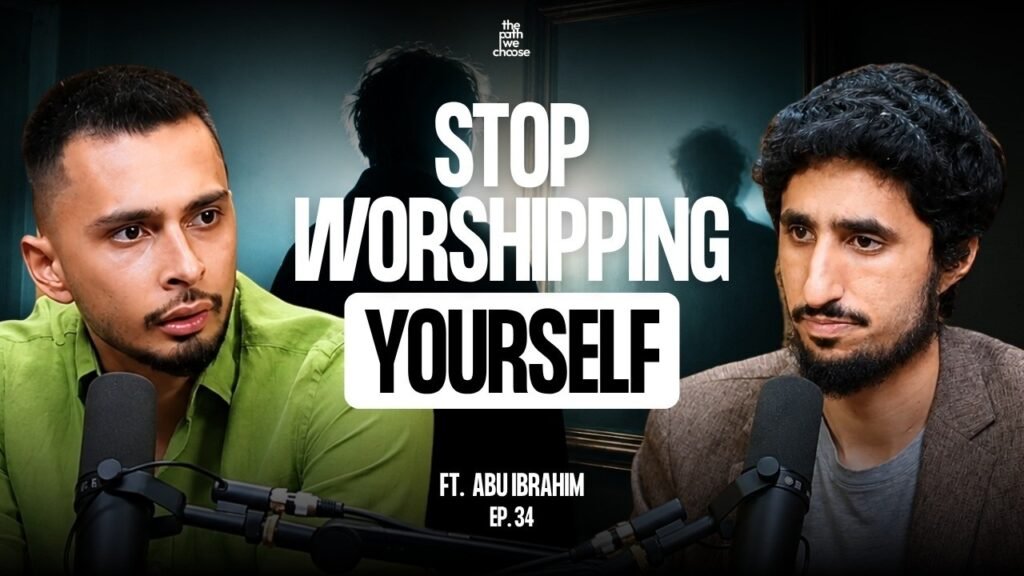
Stop Worshipping Yourself | Abu Ibrahim | Ep. 34
Hey everyone, Umer here!
Most Muslims know they were created to worship Allah. But the real question is whether we have reduced worship to rituals, while leaving the rest of life to systems that have nothing to do with Islam.
That was the heart of this conversation with Abu Ibrahim. The episode moved through Islamic civilization, secularism, politics, the Quran, Islamic self-improvement, scholarship, organization, family, sacrifice, and what it really means to serve the ummah.
“The path I’m on is the path of reestablishing Islamic civilization.”
Here’s what I learned.
Ibadah Is Bigger Than Rituals
Abu Ibrahim spoke about growing up religious, praying, thinking about qadar, and trying to live in a halal way. But he still felt a tension between success in the dunya and his Islamic purpose.
For a long time, worship meant prayer, fasting, dua, and personal religious practice. Then he began to understand ibadah in a much wider way.
“Ibadah is not just ritual worship.”
It is full submission to Allah. Not only in personal habits, but in society, law, politics, economics, family, and civilization. Once that clicked, his purpose stopped feeling divided. His skills, intelligence, and ambitions could all be placed in service of Allah’s deen.
Islam Is Not Just A Religion
One of the strongest themes in the episode was the way secularism has trained Muslims to shrink Islam. Many Muslims see Islam as a set of rituals and personal dos and don’ts, while politics, law, and social systems are treated as separate.
“Islam is not just a religion.”
Abu Ibrahim’s point was that Islam is a complete system. It does not only tell the individual how to pray. It tells society how to organize itself, how to judge disputes, how to define justice, and how to live under the authority of Allah.
The Muslim Mind Has Been Secularized
A major part of the conversation focused on de-secularizing the Muslim mind. Abu Ibrahim explained that many Muslims can easily say Islam is their religion, but when asked about politics, they will answer with liberalism, conservatism, democracy, monarchy, or something else.
That shows how deeply the separation has entered our thinking.
For him, the problem is not only that Muslim lands are politically weak. The deeper problem is that many Muslims no longer even imagine Islam as something that should govern society. They think of it as private spirituality, not public truth.
Hard Truths Need Wisdom, Not Silence
The conversation also explored why some scholars, speakers, and institutions avoid political topics. Abu Ibrahim described this as practical negation. People may not deny that Islam has political obligations, but they treat those obligations as irrelevant, unimportant, or unrealistic.
That creates a culture where people speak endlessly about safe topics, but never reach the foundations.
He was clear that wisdom matters. Not every topic needs to be spoken about in every moment. But wisdom cannot become an excuse to bury foundational truths. If something is central to Islam, avoiding it forever is not hikmah. It is fear.
The Average Muslim Is Not Useless
One important correction was around the word “layman.” Abu Ibrahim pushed back on the idea that the average Muslim has no role to play because they are not scholars.
A person can be a layman in Islamic scholarship and still be extremely capable in business, media, technology, education, design, fundraising, organizing, or leadership.
Everybody has something to contribute. The key is not isolated individual effort. The key is working within a larger organized plan, with people who have a serious proposal for the ummah.
We Need Organization, Not Just Motivation
Another major takeaway was the importance of jamaah and organization. Abu Ibrahim argued that the revival of Islamic civilization cannot happen through scattered individual posts, random projects, or personal motivation alone.
“You cannot achieve an objective of this scale without organization.”
That line matters. Even building a masjid or hospital requires a plan, a team, roles, leadership, and coordination. So how can something as serious as reviving the ummah happen through individualism? Islam teaches organization, responsibility, leadership, and obedience within the right structure.
The Quran Was Revealed For Us
The episode also challenged the way many Muslims relate to the Quran. Many of us focus on recitation, memorization, and finishing pages, but not enough on understanding what Allah is saying to us now.
Abu Ibrahim explained that one misconception is thinking the Quran was only revealed to the Prophet ﷺ and his community fourteen hundred years ago. It was revealed for us too.
When the Quran speaks about power, hypocrisy, justice, oppression, society, and obedience to Allah, the task is not only to learn what it meant then. The task is to understand what it demands from us today.
Self-Improvement Must Start With Allah
The conversation also moved into stoicism, red pill content, self-improvement gurus, and Muslim men being shaped by secular ideas of discipline and success.
Abu Ibrahim’s point was not that Muslims can never benefit from techniques like habit tracking or practical systems. The issue is when a secular source becomes your refuge, your salvation, or your source of meaning.
Before running to Marcus Aurelius, Jordan Peterson, Andrew Tate, or any self-improvement framework, the Muslim has to ask: am I praying properly? Am I connected to the Quran? Am I doing qiyam? Am I seeking help from Allah first?
Dunya Should Be In Your Hands, Not Your Heart
One of the strongest lines in the conversation was the idea that Islam does not require Muslims to abandon the dunya physically. It requires them to remove the dunya from their hearts.
“Make the dunya in our hands, not in our hearts.”
That is a powerful distinction. Muslims should seek wealth, influence, status, skills, and resources, but not for ego. Not for comfort. Not for individual success. Those things are tools to serve Allah’s deen and benefit the ummah.
Family Is Not The Final Mission
Toward the end, the conversation became very challenging. Abu Ibrahim spoke about manhood, family, sacrifice, and the idea that many Muslims have reduced responsibility to only taking care of their wife and children.
He did not deny family obligations. But he argued that family cannot become the excuse for abandoning the larger obligation to the ummah.
That was one of the most difficult parts of the episode. The point was not to neglect your family. The point was that the mission of Islam sometimes requires sacrifice, discomfort, and a family that understands it is part of something bigger than itself.
Islam Requires Everything From Us
The final message was that Muslims were not created to sell Allah a small piece of their lives and keep the rest for themselves. Islam asks for full submission.
Time, money, status, comfort, family, career, speech, and safety all come under the question: are we using them for Allah, or are we using Allah to protect our attachment to them?
Abu Ibrahim ended with the reminder that Allah has purchased from the believers their selves and their wealth in exchange for Jannah. That is the trade.
If this resonated with you, the full episode goes deeper into ibadah, secularism, Islamic politics, scholarship, Quran, organization, self-improvement, family, sacrifice, and what it really means to revive Islamic civilization.
If this resonated with you, the full episode goes deeper into purpose, struggle, marriage, Quran, Sunnah, sectarian differences, personal responsibility, and what it really means to build a life around Allah instead of simply following the world.
Watch Full Episode
Thanks for tuning in. I hope this episode encourages you to live authentically and embrace your own path with resilience.
Best,
Umer Farooque
Host, The Path We Choose