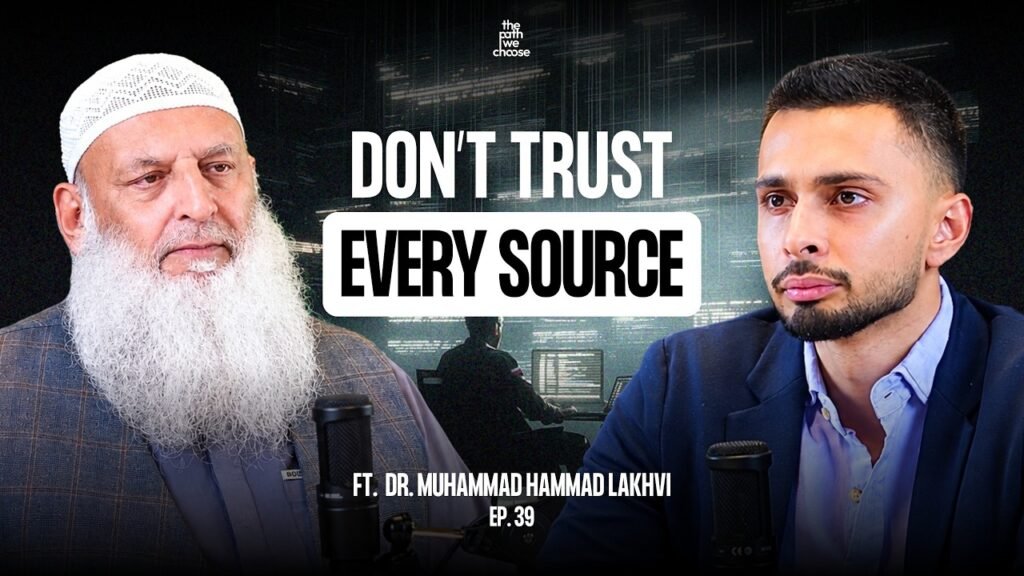
Your Test Is Different | Dr. Muhammad Hammad Lakhvi | Ep. 39
Hey everyone, Umer here!
Sometimes we spend so much time trying to choose the right path that we forget something important: perhaps the path is not entirely ours to choose. That was the heart of this conversation with Dr. Hammad, who reflected on the different directions he imagined for his life and how Allah ultimately brought him somewhere he had never planned to be.
He wanted to become a cricketer. Then a businessman. Then an engineer. Later, he wanted to become a CSS officer. None of those plans became his final destination, and looking back, he saw something deeper in that journey.
“I didn’t choose. My Allah chose.”
Here’s what I learned.
Sometimes Your Plans Have To Break
Dr. Hammad began with the saying attributed to Hazrat Ali رضي الله عنه about recognizing Allah through the breaking of one’s plans. He explained that many of the intentions he had for his own life changed over time, while Allah had already chosen a different path for him. What felt like a series of changing plans eventually became a realization that there was an allocation written for him.
That idea stood out because we often interpret a change of direction as failure. We assume that if something did not happen according to our original plan, something must have gone wrong. But sometimes the change itself is part of the journey Allah has chosen for us.
Every Person Has A Different Examination
One of the strongest ideas in the conversation was that every person has a different examination in this world. Allah gives different people different abilities, responsibilities, circumstances, and opportunities, which means that the question presented to one person will not necessarily be the question presented to another.
Dr. Hammad explained that Allah may test one person through business while another person may be tested through a completely different responsibility. The important thing is not whether your test looks like someone else’s. It is whether you fulfill the responsibility Allah has placed in front of you.
Give Your Maximum Effort
Dr. Hammad explained that throughout the different stages of his life, he tried to approach whatever opportunity was in front of him with maximum effort. Even when a particular path did not necessarily match his personality or preferences, he did not use that as a reason to hold back.
“My responsibility is to put in my maximum effort.”
That became his approach. Do what is required of you, give the opportunity everything you can, and then place your trust in Allah. The result is not something we completely control, so our responsibility is to make the effort and leave the outcome to the One who controls it.
Your Capacity Is Not My Capacity
The conversation then moved into something that is especially relevant today: comparison. We constantly look at what other people are achieving and wonder why our own results do not look the same. But Dr. Hammad explained that this comparison ignores one fundamental reality: Allah has not given everyone the same capacity.
He gave the example of two students. One may study for two hours while another studies for four, but that does not automatically mean the second student worked harder. The first person may have used one hundred percent of the capacity Allah gave them, while the second may have used only fifty percent of theirs. The amount of effort has to be understood in relation to the capacity a person was given.
You Are Responsible For The Effort, Not The Result
This led to one of the clearest principles in the conversation. We often think that achieving the target is part of our responsibility, but Dr. Hammad made a distinction between striving toward something and actually receiving the result.
“Our responsibility is only to make the effort. Reaching the target is in Allah’s hands.”
That is where tawakkul comes in. You still have to work hard and make the right effort, but you cannot make the outcome the condition for believing that your effort was worthwhile. If you are working in the right direction and doing everything within your capacity, the result belongs to Allah.
How Do You Know You Are On The Right Path?
The conversation then asked a much deeper question: if someone is working hard, has a happy family, gives charity, and feels satisfied with their life, how do they actually know that they are on the right path?
Dr. Hammad’s answer was that the definition of the right path depends on the source of knowledge we use. We cannot simply decide that something is right because our feelings, family, culture, or personal preferences tell us that it is right. For a Muslim, there has to be a more authentic source from which that understanding comes.
Go Back To The Original Source
One of the most memorable analogies in the conversation was about water. If you want pure water, you have to go back to the source. The further water travels through different environments, the more opportunities there are for outside things to affect it.
Dr. Hammad used that idea to explain why Muslims need to be careful about where their religious knowledge comes from. He emphasized the Qur’an and authentic hadith as the primary sources and explained that the science of hadith authentication exists precisely to determine what can reliably be attributed to the Prophet ﷺ.
Don’t Just Ask What Halal Or Haram Is
The conversation also challenged the way we sometimes approach religious questions. Instead of simply asking a scholar whether something is halal or haram, Dr. Hammad suggested changing the question.
“Ask what the Prophet ﷺ said about it.”
That shift is important because it keeps the authority connected to the original source. A teacher or scholar can help us understand the evidence, but the goal should not be to become attached to the individual. The goal is to become connected to the chain of knowledge that leads back to the Qur’an and the teachings of the Prophet ﷺ.
Different Opinions Do Not Always Mean Someone Is Wrong
Another important part of the conversation was the discussion around differences of opinion. Dr. Hammad explained that if two people sincerely try to reach the authentic sources, rely on evidence, and then arrive at slightly different understandings, that difference does not necessarily mean that one person has abandoned the right path.
He gave the example of the companions who understood the Prophet’s ﷺ instruction regarding the prayer at Banu Qurayzah differently. Some prayed on the journey because they understood the instruction as an emphasis on reaching the destination quickly, while others waited until they arrived because they understood the instruction literally. The Prophet ﷺ accepted both understandings.
Basic Knowledge Is A Responsibility
The conversation also addressed how much religious knowledge an ordinary Muslim is actually responsible for learning. Dr. Hammad explained that every Muslim does not need to become a specialist in Islamic scholarship, just as every person does not need to become a specialist in every academic field.
But there is foundational knowledge that every Muslim needs in order to live their life correctly. That includes understanding the Qur’an, knowing its basic rights, and learning the guidance of the Prophet ﷺ relevant to the situations a person will encounter from birth to death.
The point is not that everyone needs to become a scholar. A person can specialize in medicine, engineering, business, education, or any other field. But whatever profession they choose, their basic knowledge of revelation should remain part of their foundation.
Your Profession Can Become Part Of Your Deen
Perhaps one of the most practical parts of the conversation was the explanation that your profession does not separate you from your religious responsibility. Allah may allocate one person to medicine, another to engineering, another to business, and another to teaching. Each person can use that allocation in a way that serves the purposes of revelation.
Dr. Hammad gave the example of an engineer who uses his knowledge to build mosques or educational institutions. The profession itself is not the issue. What matters is the purpose behind it and whether the person continues to live according to the commands of Allah and His Messenger ﷺ.
The Business Counter Can Be Your Test Too
The conversation made this idea particularly practical through the example of business. A person sitting behind a business counter is just as much within their examination as someone sitting in a mosque. The question is how they behave in that position.
Dr. Hammad explained that a businessperson can move toward reward through honesty and trustworthiness, while dishonesty and false oaths can turn the same profession into a source of wrongdoing. The allocation itself is not what determines the outcome. It is what you do with the allocation Allah has given you.
Your Character Is Your Dawah
The conversation ended with a powerful reminder about dawah. You do not have to become a professional religious speaker to invite people toward Islam. You do not need to stand on a stage or give long speeches.
Dr. Hammad shared the story of a Pakistani student in the UK who worked during the evening, maintained his prayers, and would wake for tahajjud. His landlords heard him crying while speaking to Allah and asked him why he was crying. He explained that he was crying before Allah because he wanted to be saved from Hellfire. That interaction eventually became a means through which the family accepted Islam.
“The greatest dawah is the dawah of character.”
That may be the most fitting way to end the conversation. Wherever Allah has placed you, that place is part of your examination. Your workplace, your family, your business, your university, and even your private moments are opportunities to show what it means to live according to Islam.
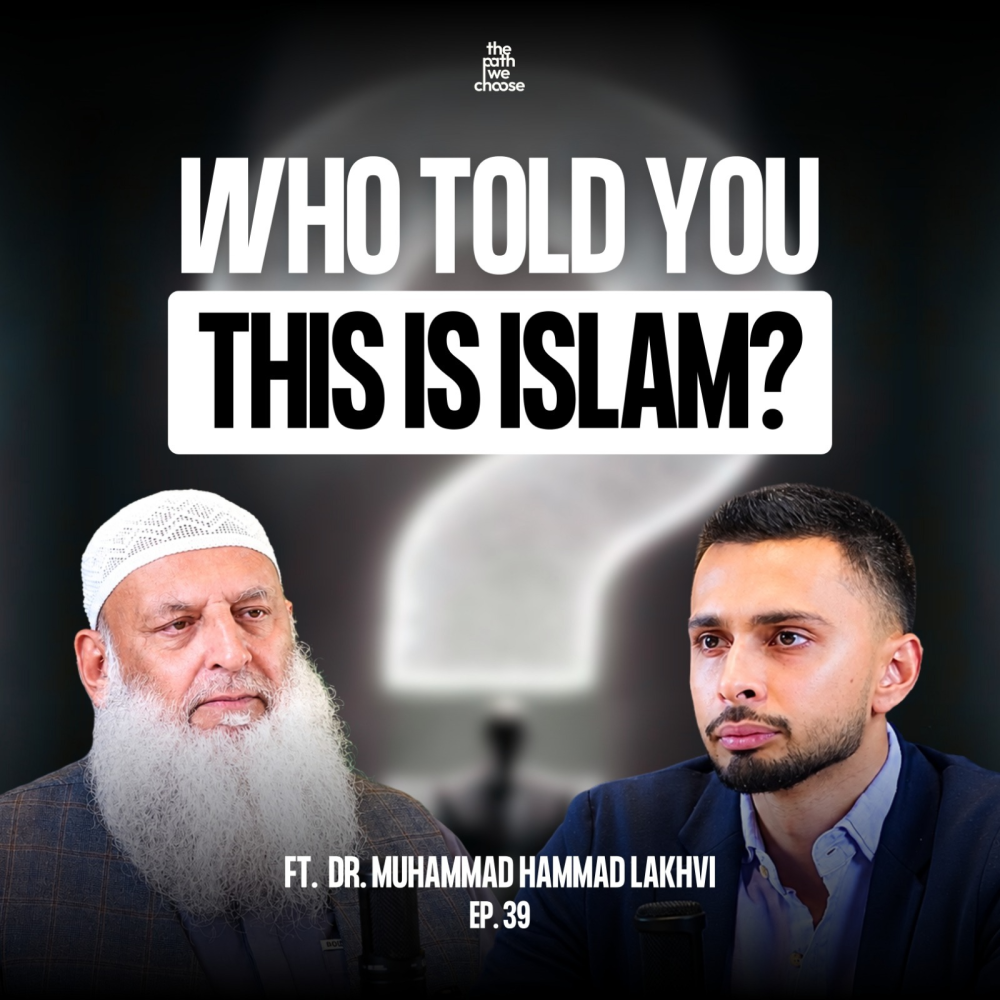
If this resonated with you, the full episode goes deeper into Allah’s allocation, hard work, comparison, tawakkul, finding the right path, authentic religious knowledge, differences of opinion, basic Islamic education, and what it really means to live your faith wherever Allah has placed you.
Watch Full Episode
Thanks for tuning in. I hope this episode encourages you to live authentically and embrace your own path with resilience.
Best,
Umer Farooque
Host, The Path We Choose